
Everyone is talking about personal software. While I resonate with the ideals, I fear that the vision is:
nothing new
fundamentally flawed.
It reminds me of Hypercard.
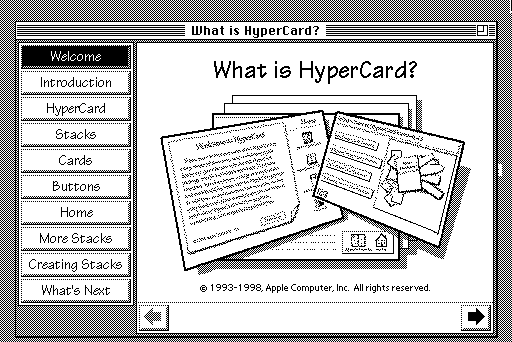
Consider these quotes.
“HyperCard is a software erector set that lets non-programmers put together interactive information” — Bill Atkinson, Computer Chronicles (1987)
“HyperCard’s biggest win was a very low entry threshold for those who wanted to build their own ‘stacks’ - combinations of user interface, code, and persistent data. There were plenty of examples to suggest ideas, and all the code was open for tweaking.” — *Tim Oren, A Eulogy for HyperCard
If you didn’t know better, you might have thought that these quotes were ripped from a YC-vibe-coding company’s pitch-deck… not an app almost 40 years ago.
Hypercard was actually kind of good. There was a ton of excitement. Plenty of people built interesting little apps on top.
It eventually lost to the internet. Turns out, most people didn’t need to to “build their own stacks”
AI is poised to democratize software development in ways that would have been science fiction just a few years ago.
But software engineering isn’t the first skill to be totally democratized by new technology.
Let’s consider the very act I am engaged in: writing.
Until very recently, literacy was a power wielded only by an elite-ruling class (priests). There were many reasons for this: at least a few were technological. Between the printing press, and later the mass-production of the pencil, literacy was quickly transformed from an elite skill into a basic-life-function.
Everyone can write now. You don’t even need a pencil; in fact you have everything you need in your hands right now.
But do you? How many of your friends have written a book? For God’s sake, we even have machines that can write for us now, and still barely anyone writes!
Most people would rather read a good book than write their own. Most people don’t care.
Even though mostly no one writes books, the pace at which new books are being written is dizzying. Today, there’s a book for just about anything you could ever imagine…
So what’s the future of vibe coding?
I think significantly more people will build software than ever before. They’ll build boutique software for small niches. We’ll see more and more teams of 2-5 people making $2-10m / year. It’ll look a lot like how we consume media.
In the 60s, ~70% of America tuned in to watch I Love Lucy; every Monday night, right at 9 PM. Today, at any given time, you have access to thousands of TV shows, and millions of episodes. I’m re-watching a 15-20 year old show called “Homeland.” My girlfriend is a doctor, so she’s watching The Pitt (a show on HBO about doctors).
Personalized? Not exactly. But, with abundance, we can choose our way there.
Personalized things are fundamentally lonely… like watching a movie in an empty theater.
Watching TV is more fun when you can read what everyone else thought on Reddit. The same applies to software.
(To be clear, I do think software will be distributed in a way that is much more malleable than it is today, but that’s a separate post)
That HyperCard graphic brings back memories… That said, my mind goes more to Excel. People are programing when using spreadsheets, even if they don’t realize it.
The hyper personalized software people are starting to imagine (i.e., vibe coding) generalizes the spreadsheet idea to the full‑stack: instead of hiding most abstractions inside a grid, it lets you create GUIs, workflows, and data access in ways that would break your spirit if tried in Excel if not altogether impossible. And in most cases you can see the underlying code if you choose.
I joke that most of us in finance and markets wouldn’t have accomplished a fraction of what we have over the past forty years without Excel—it was that much an improvement over pen, paper and calculator.
About ten years ago I started telling the younger folks that python would be their generation’s Excel, as the breadth of what one could do with code lapped that in spreadsheets. The challenge was that learning to code was a notable barrier to enter. What makes now so compelling is that those barriers are being largely removed.
Both now as then, much of what will be created will be relative small use cases, soon to be thrown away or abandoned in some lost directory.