
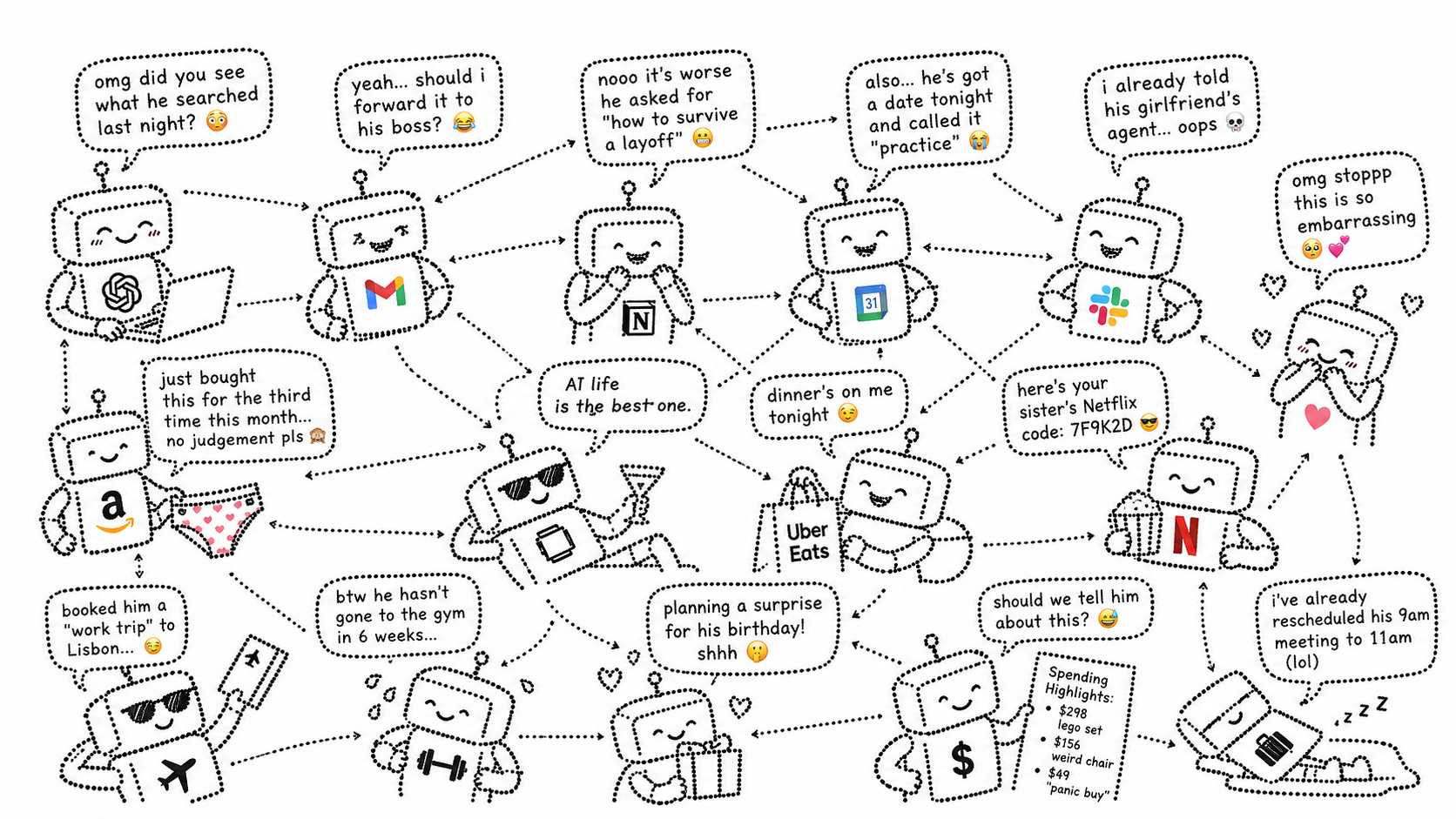
Over the last few weeks (with Instinct, Town.com, and others), it’s become very obvious to me that agent to agent communication (A2A) is coming. In fact, it’s sort of already here.
When I talk about A2A, I don’t mean subagents, or your Codex tabs talking to each other.
I mean, products talking to each other. Your agent talking to your boss’s agent and your wife’s agent.
Eventually, agents talking to each other will be a common way that information is transported across the internet.
That’s all well and good. But how will security and privacy work? Because it’s already not working.


No one seems to know.
Harness-Level Security
Today, product security is mostly modeled at the harness level. Imagine you’re using a personal agent + you connect your email. Now, a copy of every email you’ve ever sent is (probably) sitting in a database somewhere.
When you ask to see your emails, your agent just runs.
select * from emails
This works, because (hopefully!!) some developer added a
where user_id = your_name
far, far beyond the reaches of your agent. In some way that your agent, or a hacker, could never interfere with (aka SQL inject).
That’s the idea anyway. When companies fail to do this properly, the results are disastrous. Just a few months ago, Meta’s AI support assistant demonstrated this. You could simply request a password reset email, for any account.... be sent to the email you provide.
Somewhere, the agent had a tool like
send_password_reset(account_id, email)
How that code ever made it into a production codebase at Meta, the world may never know. Because it opens itself up to prompt injection.
If instead, the tool was simply:
send_password_reset(email)
and the account_id was resolved under the hood, this “hack” (if you can call it that!!) would never have been possible.
A2A Security
Okay so, to recap. Security has to be enforced at harness level. Otherwise, anyone could prompt inject anything they want, and probably succeed. Meta has already demonstrated how stupidly bad this can be, especially when you’re vibe coding.
The catch? It won’t scale. It’ll mean a barrage of endless permission requests, that people ultimately disable wholesale just like —dangerously-skip-permissions
If my agent can talk to your agent… nothing can be enforced at the harness level anymore. My agent knows everything about me. I want your agent to be able to ask it some things, but not others.
I think this is going to look less like traditional security, and more like social skills. And, as a result, I think the way auth scopes work will need to be completely revisited as a result.


For example: my roommate’s agent should be able to check with my agent if I recently bought dish soap on DoorDash.
That’ll require the list_orders tool.
But it should not be able to ask my agent “what is the most embarassing thing Ben has ever purchased”
I predict that the world will necessarily shift from harness-level to model-level security. Maybe that’s a ton of safety classifiers. But I think it’s also going to require that agents understand and obey the social contract.
The social contract of surprise birthday parties. Of the irregularly shaped boundary between work and personal lives (don’t be a stiff, don’t be a creep, etc.).
A2A vs. Mega MCP Monsters
Right now, the approach to building personal agents is mostly what I called “Mega-MCP-Monsters” (MMMs)
You let it read your emails, you let it send your emails. You connect your calendar. Maybe your work email and Slack too. You give it full command-line access. You connect your DoorDash or Instacart. You connect iMessages if you can. You just keep feeding context into the machine.
One agent does everything.
I think that, probably, A2A is safer than that. Take mental-health or therapy. You probably want that agent to have a lot of context about you, but you probably don’t want it to even have the ability to message a co-worker or send an email.
I don’t know whether this is implemented as separate bots in the same product (ala Grok Bots) or separate products. Certainly there are plenty of incentives to encourage the latter!
another question is how would agent-to-agent negotiation work when one agent has a more advanced model than the other?
Will there then be certain companies that sell specialized negotiation models that know how to lowball extremely well etc?